

1. 组网需求
由于公司人员激增,接入层交换机提供的端口数目已经不能满足 PC 的接入需求。现需要在保护现
有投资的基础上扩展端口接入数量,并要求网络易管理、易维护。
2. 组网图
3. 配置思路
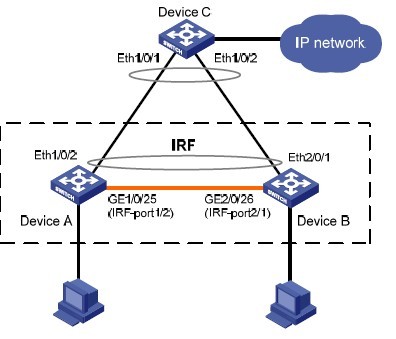
Device A 提供的接入端口数目已经不能满足网络需求,需要另外增加一台设备Device B。(本文以两台设备组成IRF 为例,在实际组网中可以根据需要,将多台设备组成IRF,配置思路和配置步骤与本例类似)
鉴于第二代智能弹性架构 IRF 技术具有管理简便、网络扩展能力强、可靠性高等优点,所以本例使用IRF 技术构建接入层(即在Device A 和Device B 上配置IRF 功能)。
为了防止万一 IRF 链路故障导致IRF 分裂、网络中存在两个配置冲突的IRF,需要启用MAD检测功能。因为接入层设备较多,我们采用LACP MAD 检测。
4.配置步骤
(1) 配置设备编号# Device A 保留缺省编号为1,不需要进行配置。
# 在Device B 上将设备的成员编号修改为2。
<DeviceB> system-view
[DeviceB] irf member 1 renumber 2
Warning: Renumbering the switch number may result in configuration change or loss. Continue?
[Y/N]:y
[DeviceB]
(2) 将两台设备断电后,按图所示连接IRF链路,然后将两台设备上电。
# 在Device A 上创建设备的IRF 端口2,与物理端口GigabitEthernet1/0/25 绑定,并保存配置。
<DeviceA> system-view
[DeviceA] interface gigabitethernet 1/0/25
[DeviceA-GigabitEthernet1/0/25] shutdown
[DeviceA] irf-port 1/2
[DeviceA-irf-port1/2] port group interface gigabitethernet 1/0/25
[DeviceA-irf-port1/2] quit
[DeviceA] interface gigabitethernet 1/0/25
[DeviceA-GigabitEthernet1/0/25] undo shutdown
[DeviceA-GigabitEthernet1/0/25] save
# 在Device B 上创建设备的IRF 端口1,与物理端口GigabitEthernet2/0/26 绑定,并保存配置。
<DeviceB> system-view
[DeviceB] interface gigabitethernet 2/0/26
[DeviceB-GigabitEthernet2/0/26] shutdown
[DeviceB] irf-port 2/1
[DeviceB-irf-port2/1] port group interface gigabitethernet 2/0/26
[DeviceB-irf-port2/1] quit
[DeviceB] interface gigabitethernet 2/0/26
[DeviceB-GigabitEthernet2/0/26] undo shutdown
[DeviceB-GigabitEthernet2/0/26] save
# 激活DeviceA 的IRF 端口配置。
[DeviceA-GigabitEthernet1/0/25] quit
[DeviceA] irf-port-configuration active
# 激活DeviceB 的IRF 端口配置。
[DeviceB-GigabitEthernet2/0/26] quit
[DeviceB] irf-port-configuration active
(3) 两台设备间会进行Master 竞选,竞选失败的一方将自动重启,重启完成后,IRF 形成,系统
名称统一为DeviceA。
(4) 配置LACP MAD 检测
# 创建一个动态聚合端口,并使能LACP MAD 检测功能,由于并不是在两个IRF 之间配置LACP
MAD 检测,因此在系统提示输入IRF 域ID 时,可以保持为默认值0。
<DeviceA> system-view
[DeviceA] interface bridge-aggregation 2
[DeviceA-Bridge-Aggregation2] link-aggregation mode dynamic
[DeviceA-Bridge-Aggregation2] mad enable
You need to assign a domain ID (range: 0-4294967295)
[Current domain is: 0]:
The assigned domain ID is: 0
Info: MAD LACP only enable on dynamic aggregation interface.
[DeviceA-Bridge-Aggregation2] quit
# 在聚合端口中添加成员端口Ethernet1/0/1 和Ethernet2/0/1,专用于两台IRF 成员设备与中间设
备进行LACP MAD 检测。
[DeviceA] interface ethernet 1/0/1
[DeviceA-Ethernet1/0/1] port link-aggregation group 2
[DeviceA-Ethernet1/0/1] quit
[DeviceA] interface ethernet 2/0/1
[DeviceA-Ethernet2/0/1] port link-aggregation group 2
(5) 中间设备Device C 的配置
Device C 作为一台中间设备需要支持LACP 功能,用来转发、处理LACP 协议报文,协助Device A
和Device B 进行多Active 检测。从节约成本的角度考虑,使用一台支持LACP 功能的交换机即可。
# 创建一个动态聚合端口。
# 创建一个动态聚合端口。
<DeviceC> system-view
[DeviceC] interface bridge-aggregation 2
[DeviceC-Bridge-Aggregation2] link-aggregation mode dynamic
[DeviceC-Bridge-Aggregation2] quit
# 在聚合端口中添加成员端口Ethernet1/0/1 和Ethernet1/0/2,用于进行LACP MAD 检测。
[DeviceC] interface ethernet 1/0/1
[DeviceC-Ethernet1/0/1] port link-aggregation group 2
[DeviceC-Ethernet1/0/1] quit
[DeviceC] interface ethernet 1/0/2
[DeviceC-Ethernet1/0/2] port link-aggregation group 2
