


1. 组网需求
由于网络规模迅速扩大,当前中心交换机(Device A)转发能力已经不能满足需求,现需要在保护现有投资的基础上将网络转发能力提高一倍,并要求网络易管理、易维护。
2. 组网图
3. 配置思路
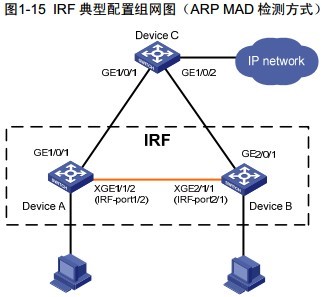
Device A处于局域网的汇聚层,为了将汇聚层的转发能力提高一倍,需要另外增加一台设备Device B。
鉴于第二代智能弹性架构IRF 技术具有管理简便、网络扩展能力强、可靠性高等优点,所以本例使用IRF技术构建网络接入层(即在Device A和Device B上配置IRF功能),IRF通过双链路上行。
为了防止万一IRF链路故障导致IRF分裂、网络中存在两个配置冲突的IRF,需要启用MAD检测功能。因为成员设备比较少,我们采用ARP MAD检测方式来监测IRF的状态,复用链路上行传递ARP MAD报文。为防止环路发生,在IRF和Device C上启用生成树功能。
4. 配置步骤
(1) 配置设备编号
# Device A保留缺省编号为1,不需要进行配置。
# 在Device B上将设备的成员编号修改为2。
<DeviceB> system-view
[DeviceB] irf member 1 renumber 2
Warning: Renumbering the switch number may result in configuration change or loss. Continue? [Y/N]:y
[DeviceB]
(2) 将两台设备断电后,按图1-14所示连接IRF链路和ARP MAD检测链路,然后将两台设备上电。
# 在Device A上创建设备的IRF端口2,与物理端口Ten-GigabitEthernet1/1/2绑定,并保存配置。
<DeviceA> system-view
[DeviceA] interface ten-gigabitethernet 1/1/2
[DeviceA-Ten-GigabitEthernet1/1/2] shutdown
[DeviceA] irf-port 1/2
[DeviceA-irf-port1/2] port group interface ten-gigabitethernet 1/1/2
[DeviceA-irf-port1/2] quit
[DeviceA] interface ten-gigabitethernet 1/1/2
[DeviceA-Ten-GigabitEthernet1/1/2] undo shutdown
[DeviceA-Ten-GigabitEthernet1/1/2] save
# 在Device B上创建设备的IRF端口1,与物理端口Ten-GigabitEthernet2/1/1绑定,并保存配置。
<DeviceB> system-view
[DeviceB] interface ten-gigabitethernet 2/1/1
[DeviceB-Ten-GigabitEthernet2/1/1] shutdown
[DeviceB] irf-port 2/1
[DeviceB-irf-port2/1] port group interface ten-gigabitethernet 2/1/1
[DeviceB-irf-port2/1] quit
[DeviceB] interface ten-gigabitethernet 2/1/1
[DeviceB-Ten-GigabitEthernet2/1/1] undo shutdown
[DeviceB-Ten-GigabitEthernet2/1/1] save
# 激活DeviceA的IRF端口配置。
[DeviceA-Ten-GigabitEthernet1/1/2] quit
[DeviceA] irf-port-configuration active
# 激活DeviceB的IRF端口配置。
[DeviceB-Ten-GigabitEthernet2/1/1] quit
[DeviceB] irf-port-configuration active
(3) 两台设备间将会进行Master竞选,竞选失败的一方将自动重启,重启完成后,IRF形成,系统名称统一为DeviceA。
(4) 配置ARP MAD
# 在IRF上全局使能MSTP,以防止环路的发生。
<DeviceA> system-view
[DeviceA] stp enable
# 按图1-15所示连接ARP MAD检测链路。
# 将IRF配置为MAC地址立即改变。
[DeviceA] undo irf mac-address persistent
# 创建VLAN 3,并将Device A(成员编号为1)上的端口GigabitEthernet1/0/1和Device B(成员编号为2)上的端口GigabitEthernet2/0/1加入VLAN中。
[DeviceA] vlan 3
[DeviceA-vlan3] port gigabitethernet 1/0/1 gigabitethernet 2/0/1
[DeviceA-vlan3] quit
# 创建VLAN-interface3,并配置IP地址,使能ARP MAD检测功能。
[DeviceA] interface vlan-interface 3
[DeviceA-Vlan-interface3] ip address 192.168.2.1 24
[DeviceA-Vlan-interface3] mad arp enable
(5) 配置Device C
# 在全局使能MSTP,以防止环路的发生。
<DeviceC> system-view
[DeviceC] stp enable
# 创建VLAN 3,并将端口GigabitEthernet1/0/1和GigabitEthernet1/0/2加入VLAN 3中,用于转发ARP MAD报文。
[DeviceC] vlan 3
[DeviceC-vlan3] port gigabitethernet 1/0/1 gigabitethernet 1/0/2
[DeviceC-vlan3] quit
IRF的介绍请看 http://www.elvhome.com/html/2013-3-3/2013331664814505.html
IRF典型配置举例LACP MAD检测方式 http://www.elvhome.com/html/2013-3-3/20133316395949733.html
BFD MAD检测方式的IRF典型配置举例 http://www.elvhome.com/html/2013-3-3/20133316535917854.html
